Field NoteComing Soon
Could It Be Burnout?
How exhaustion becomes invisible until it can't be ignored.
An upcoming field observation on how burnout takes hold long before anyone names it, and what changes once it does.
Read previewCare often begins before anyone uses the word caregiving.
Audio introduction
Introduction by Meamya Christie
Introduction and signature by Meamya Christie. Music: "Softness Tech Ambient" by Rockot, via Pixabay.
Field Note
Field Note 001 · Care & Continuity Series
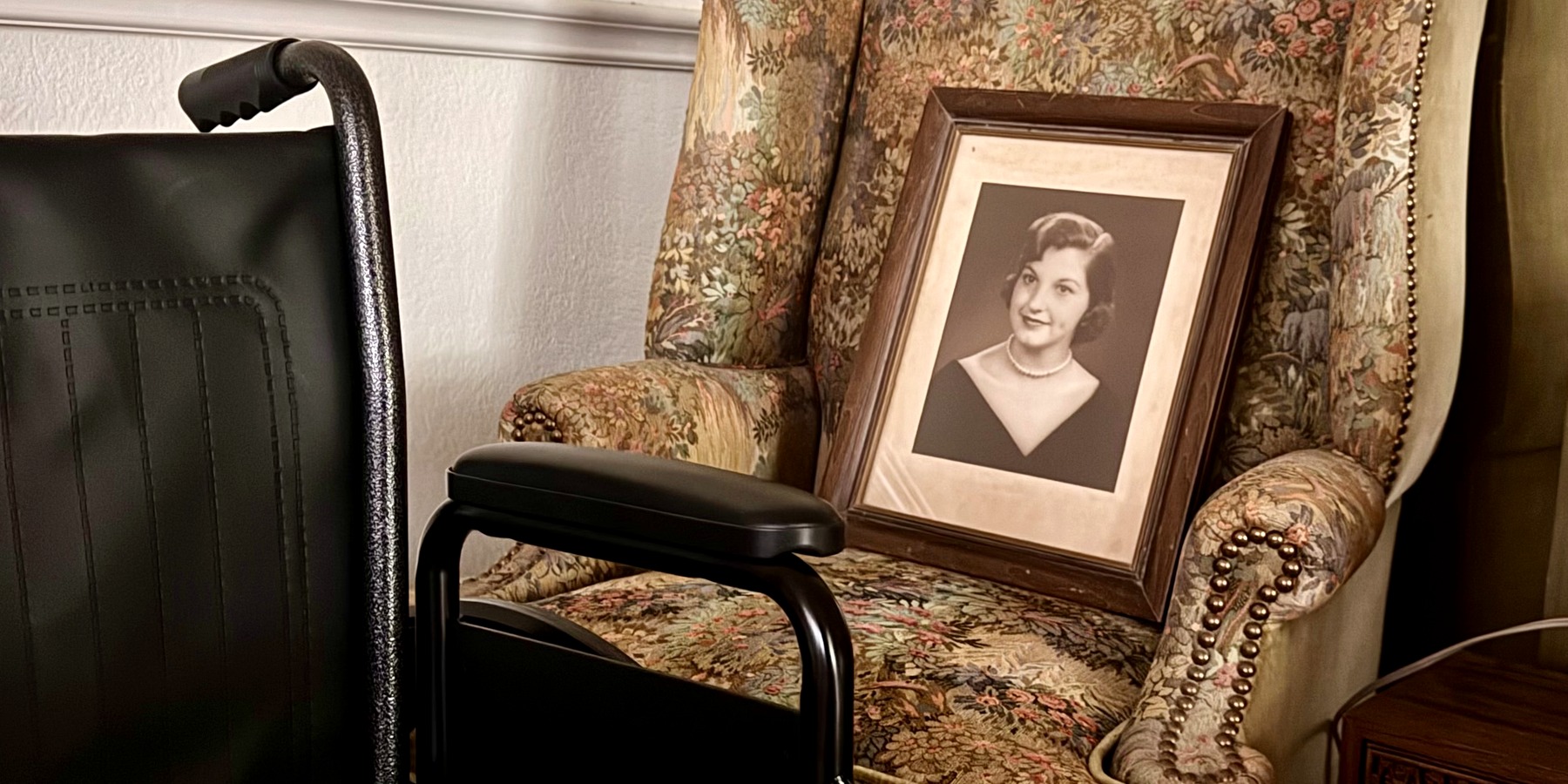
Reflection Care often begins before anyone uses the word caregiving. The work first appears as updates, errands, meals, transportation, observation, and the effort to make sure that someone does not have to carry illness alone.
Most people who are caregiving right now would not call themselves that. It shows up first as an extra errand, a missed call returned twice, a schedule quietly reorganized around someone else's needs, long before anyone uses the word. It is common, it is becoming more common as people live longer with more complex conditions, and it remains one of the least structurally supported kinds of work most people will ever do.
01 — WHY THIS MATTERS NOW
The number of older adults in the United States is growing at a pace the country's care systems have not caught up to. The Population Reference Bureau projects, using U.S. Census Bureau population data and projections, that the population age 65 and older will rise from roughly 58 million in 2022 to about 82 million by 2050, growing from 17 percent to 23 percent of the total population.[3] That is not a distant demographic curiosity. It is a shift already visible in how many households are quietly reorganizing around an aging parent, spouse, or neighbor.
Much of the resulting care work falls to people who never applied for the role. According to the 2025 Caregiving in the US survey from AARP and the National Alliance for Caregiving, an estimated 63 million Americans, close to one in four adults, now provide unpaid care to a family member, a 45 percent increase since 2015.[2] Many are doing this alongside paid work, parenting, and their own health needs, with no formal training and little institutional support.
The work itself has also grown more complex. The same survey finds that nearly three in ten family caregivers are now part of the "sandwich generation": caring for both a child under 18 and an adult with a disability in their home, not necessarily an aging adult. Caregivers increasingly describe rising emotional stress, health strain, and financial pressure as the responsibilities they carry become longer, more layered, and less occasional.
The systems meant to relieve some of that burden are strained in their own way. PHI, a research organization focused on the direct care workforce, projects that the direct-care workforce will add more than 772,000 jobs between 2024 and 2034. When openings created by workers transferring occupations or leaving the labor force are included, an estimated 9.7 million direct-care positions will need to be filled during that period.[1] The American Hospital Association reported in 2022 that nursing homes and home health agencies were already turning away referrals and limiting new admissions because they could not staff the care they were asked to provide.[4]
Technology is increasingly proposed as part of the response, particularly for remote monitoring, care coordination, documentation, scheduling, and communication. But expanding the amount of technology in care does not automatically improve continuity or quality. Systems can make tasks more visible while leaving responsibility, relationships, dignity, and the changing orientation of care unresolved. These are the wider conditions this report sits inside; what follows is a close look at one household where those conditions became visible in daily, specific, and often unglamorous ways.
02 — WHY THIS REPORT AND EDITORIAL STANCE
This report documents what became visible to me through direct caregiving and adjacent observations: how a need for care first becomes visible, how people gather around a person, where continuity breaks, how the orientation of care changes, and what caregivers carry before, during, and after the end of a life. It asks what technology should do as support moves from individual control, to informal help, to sustained caregiving, and sometimes to professional services.
Caregiving has appeared at different points across my life, involving different people, relationships, circumstances, and outcomes. More than thirty years separate my earliest family caregiving experience from caring for Ms. Dottie, an older woman living at home with dementia and serious illness whom I cared for later in life, yet many logistical problems remained recognizable: information still traveled through private memory, repeated conversations, paper, individual phones, and assumptions about who was responsible for the next step.
This is a practice-based field note and design essay, grounded most deeply in that experience caring for Ms. Dottie. I documented that work while it was happening. Those records became both a field archive and the foundation for Delala, a care-coordination concept. Delala is a shared place to track schedules, notes, and handoffs among the people supporting one person's care, and it emerged inside the actual work rather than apart from it.
I also include two newer observations: a family member preparing to begin chemotherapy and a neighbor who described experiencing serious illness alone. These extend that understanding into moments closer to the very beginning of a care journey, before a diagnosis, illness, injury, or change in capacity has settled into anything resembling routine. They are emerging field signals, not evidence of the same depth as the Ms. Dottie experience.
While caring for Ms. Dottie, I came to understand that care is not only a set of visible tasks. It is also the work of noticing, interpreting, anticipating, translating, following through, and helping someone remain a person rather than a diagnosis or a schedule. The central concern of this report is therefore not efficiency alone. It is whether continuity can be improved without stripping care of relationship, context, privacy, or dignity.
Throughout, I distinguish direct observation, participant statements, interpretation, and design propositions. I do not treat every need as proof that a product response is appropriate.
Privacy and protection. Names and potentially identifying details in this report have been changed or omitted to protect the people whose experiences informed the work. Some scenes are compressed or described at a level of detail intended to preserve meaning without exposing private identity. The report does not disclose clinical records.
This is not a clinical study, medical protocol, or legal analysis. It is an observation in the field: a record of practice, reflection, and design questions about continuity, dignity, and the frequently invisible architecture that allows care to happen.
| Evidence type | What it represents | How it should be read |
|---|---|---|
| Direct field observation | What I witnessed while caring for Ms. Dottie and coordinating day-to-day support | Sustained, first-person evidence; still limited to one deeply observed journey |
| Participant statement | What another person described about their own experience or interest | Their perspective, not independently verified outcome data |
| Emerging field signal | A newer situation that suggests a possible recurring need | A prompt for research and testing, not a conclusion |
| Interpretation | My synthesis of what the experience may mean | A reasoned view that remains open to revision |
| Design proposition | A possible response to test | A hypothesis to test, not a finding |
03 — APPROACH TO THIS FIELD NOTE
This inquiry emerged over approximately eight weeks, from June through August 2026, while I participated directly in an active home-care environment as a caregiver, coordinator, and designer. The material informing the report includes contemporaneous observations, care logs and handoffs, scheduling and communication breakdowns, care-related conversations, and insights generated while developing and using early Delala workflows.
This was not a clinical trial or a series of formal research interviews. I did not enter the environment as a detached researcher. The inquiry developed through practice: participating in care, documenting what became visible, building responses to immediate problems, and observing what changed when those responses were used.
That practice drew on several different kinds of source material, and this report tries not to blur them together. My direct work caring for Ms. Dottie is the most sustained and closely observed record here, gathered from the inside over the full eight weeks. Conversations with other caregivers and people involved in her care circle add context, but reflect what was told to me rather than what I directly witnessed. The neighbor's and family member's statements referenced elsewhere in this report are participant statements in the strictest sense: a single person's account of a single experience, offered in passing conversation, not a verified outcome or a research interview. Within the Delala material specifically, a further line matters: what was actually built and used during this period, tested against real friction in real time, and what remains a proposed capability, discussed and designed but not yet implemented or observed in use. Keeping these categories visible, rather than letting the confidence of the writing imply more certainty than the evidence supports, is part of the method itself.
04 — THE FIELD METHOD
This report follows a working method I return to across observation-based design work, seven stages that loop rather than resolve:
This report moves through that method once: from early, divergent field signals, to the points where they converge, to the design propositions that follow, to the open questions named at the close, to what has been learned and carried forward. It is not a finished cycle. It is one pass through a loop meant to repeat, across this report and the ones that follow it.
05 — KEY FINDINGS AT A GLANCE
The sections that follow provide the evidence, detail, and reflection behind each of these findings. They are not conclusions meant to apply universally. They are findings from this field inquiry, offered to be tested across other care environments.
Join the Conversation
Enter your details to unlock the rest of this field notes and download a copy for later.
Related field notes
How exhaustion becomes invisible until it can't be ignored.
An upcoming field observation on how burnout takes hold long before anyone names it, and what changes once it does.
Read previewHow sleep becomes the first thing sacrificed, and the last thing repaired.
An upcoming field observation on how rest gets structured out of daily life, and what it takes to rebuild it.
Read preview